Review: Marlugubre – Per Amor Nymphae
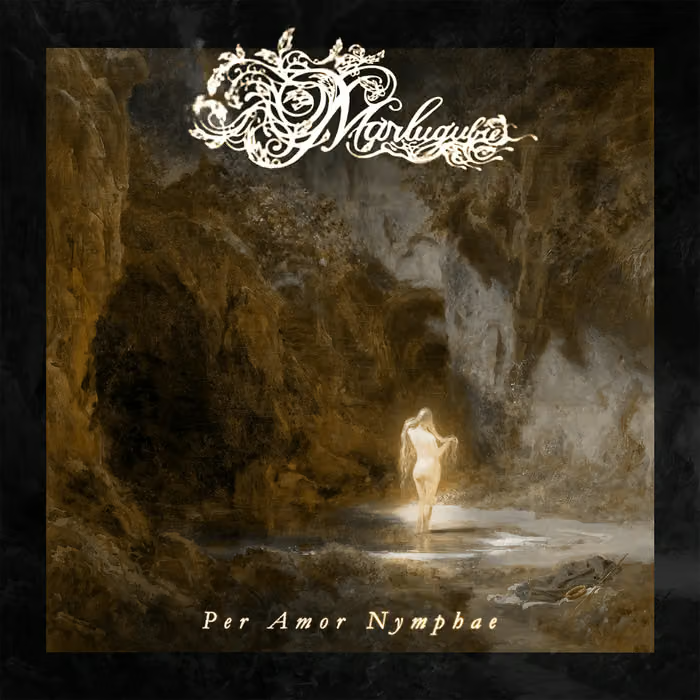
Style: Progressive death metal, progressive black metal (Mixed vocals)
Recommended for fans of: Opeth, Be’Lakor, Green Carnation, Enslaved
Country: Italy
Release date: 27 February 2026
My peers tell me that one of the great aspects of music is that it’s subjective; composer and multi-instrumentalist Tiziano Colella of Marlugubre doesn’t think so. My fifth ever review for the Subway was of the previous Marlugubre record, Maladie, and Colella left a salty comment, in which he said: “you find me not agreeing at all with the whole analysis of the review,” along with a remark that although he was open to negative reviews, he still thought I should “also try to get right what you write, to me here it sounded like the opposite.” It makes you wonder: if he didn’t agree with my kindly worded 5/10, what type of non-glowing review would he accept? I sincerely hope that in 2026, with 230 more reviews under my belt, that I have finally figured out what it takes for Colella to think I get right what I write.
In the previous four years, Marlugubre haven’t evolved their sound too much, still playing a comfortable, familiar Opethian style of prog death, interspersed with a post-black metal flair to add atmosphere and melancholia. For the most part, Marlugubre’s simple formula of classic prog death juxtaposition works—dramatic blast beat- and tremolo pick-laden extreme metal, followed by moments of serene calm— just like it has for many a prog death band before them. Many of the riffs in the extreme sections of Per Amor Nymphae are a bit nebulous—lacking a strong melody or rhythmic structure in favor of loosely strung together distorted notes—but when Colella actually throws together cohesive melodies with a true lead guitar tone, the record reaches its peaks. For instance, near the beginning of “Lips Scented Spring Roses,” the lead guitar flutters in before being blown away by a stormy black metal section, complementing the blast beats in a satisfying, Iapetus-like way. The instrumentation used throughout Per Amor Nymphae is guitar focused for the most part, switching up permutations of a trio of distorted metal guitar, clean electric guitar, and acoustic guitar. This does the job, but it does make the rare passages where other instruments are highlighted some of the strongest on the album. Some transitions feature a dreamy cello swim into the mix, in order to bridge the heavy and light sections, such as on “Beloved Scylla” and “Lips Scented Spring Roses.” And “Undine on a Lake Garden” ends with a shocking bass solo—I couldn’t actively recall a single bass part alerting the listener of its presence across the rest of the album if you held me at gunpoint.
The production on Per Amor Nymphae is capacious and yet oddly hollow, in large part contributing to what makes the riffs so amorphous. Marlugubre have created a vast sonic palette by creatively building up the atmospheres, but there’s so much space in the mix with the record being so guitar-centric, that there’s not enough instrumentation to really fill said capacity. All together, this leaves some sonic negative space that Marlugubre would benefit from filling—the record needn’t be maximalist, but something is missing texturally. At times, thankfully, the hollow production acts as a great strength for Per Amor Nymphae, and particularly as a narrative tool for the album’s storytelling. As the title literally translates to “through the love of the nymph,” Marlugubre explore several classical stories of these mythical nature goddesses, ranging from Eurydice to Scylla. In the calmer sections, the production can create a sense of detachment that feels hauntingly beautiful, almost nostalgic, just like the concept of an ephemeral forest spirit itself. “Undine on a Lake Garden” is a particularly good example of the ethereal beauty that Marlugubre can sometimes achieve.
The final aspect of Per Amore Nymphae’s sound is new fulltime vocalist, Serena de Angelis, whose delicate singing portrays the nymphs throughout the record, whether as angelic backing vocals to Colella’s harshes, or as a more predominant lead woman. Regrettably, her tone is too nasal, and she sings quite timidly—I know she imitates the dainty nymph, but more power would work well to match the divine energy. So while her voice could go a long way in solving the “album feels a little empty” problem on a future release, her seeming reluctance to fill the space with her voice doesn’t save Per Amor Nymphae.
Finding Marlugubre plagued by many of the same issues as last time, even after all these reviews over several years, is deeply ironic. I wanted to lather on praise to Per Amor Nymphae to make amends because I genuinely do want the bands I cover to succeed in progressive metal’s small niche. But I was hoping to see Marlugubre work out the kinks of Maladie more—hoping that they’d find a bit more of their own voice rather than writing decent Opethian prog death, not outstanding enough to differentiate itself except through an occasionally beautiful atmosphere. Marlugubre should take into account some of my critiques next time. Or, just maybe, I’ll never get right what I write.
Recommended tracks: Lips Scented Spring Roses, Undine on a Lake Garden, Iphigenia
You may also like: Serein, Phendrana, Piah Mater, Iapetus, Aquilus
Final verdict: 6/10
Related links: Bandcamp | Facebook | Instagram
Label: Dusktone
Marlugubre is:
– Tiziano Colella (everything)
– Serena de Angelis (vocals)


0 Comments